We recommend Orca-Mactac HT2 Offshore Vinyl for aluminium commercial vessels needing above-waterline corrosion protection and a fleet branding refresh, because it bonds to prepared raw aluminium and allows damaged sections to be replaced individually. Boat wrapping also removes paint-curing stages from the finishing programme, helping operators plan a return to service with fewer coating-related waiting periods.
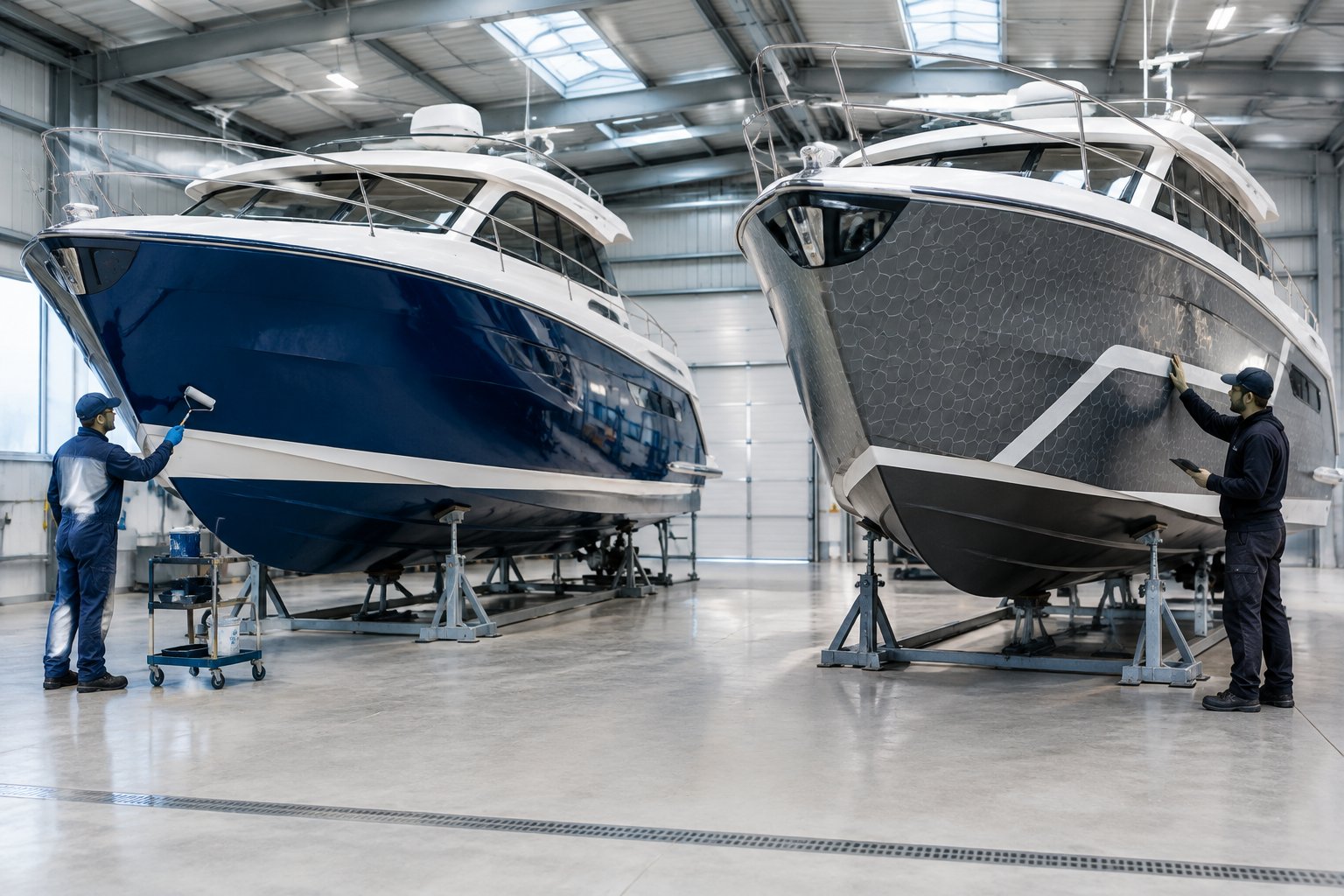
At TidalWorx, we are the exclusive UK installer of Orca-Mactac HT2 Offshore Vinyl, with a manufacturer-trained and approved installation team. Our commercial work focuses on aluminium vessels, including ferries, workboats, tugs and offshore support craft.
For fleet operators comparing wrapping vs paint for commercial vessels, the useful distinction is between complete protective systems. Specialist offshore vinyl combines a physical barrier with a finished appearance; marine paint achieves protection through a specified coating system. Your operating environment and maintenance arrangements determine how those systems should be specified.
When Does Vinyl Wrapping Make Commercial Sense?
We recommend specialist wrapping where an aluminium vessel needs renewed above-waterline protection alongside a colour change or branding update. Its commercial value increases when your maintenance programme benefits from localised repairs and fewer wet-coating stages.
Colour Changes and Fleet Branding Without a Full Repaint
Boat wraps give operators a practical way to apply fleet colours and identification across suitable hull and superstructure surfaces. Our design work accommodates logos and graphics while preserving access to equipment and required markings.
A vinyl boat wrap also supports future branding changes through replacement of the relevant film sections. The protective base film and decorative layers need to be considered together, particularly where graphics will change more frequently than the underlying finish. We recommend recording the agreed colours and artwork so subsequent vessels follow the same specification.
How Do Wrapping and Painting Compare?
Our boat wrap vs paint comparison starts with the surface and its duty. Offshore vinyl suits approved above-waterline areas; boat paint remains appropriate where a specified coating system is required for immersion, walking surfaces or particular exposure conditions.
|
Criterion |
HT2 offshore vinyl |
Marine paint |
|---|---|---|
|
Prepared raw aluminium |
Direct application |
Specified pretreatment/coats |
|
Finishing process |
Dry film application |
Coating and curing |
|
Fleet graphics |
Film-based graphics |
Painted or applied graphics |
|
Local damage repair |
Section replacement |
Local coating repair |
|
Underwater hull |
Above-waterline system |
Immersion-rated system required |
We also assess detailed shapes and working surfaces separately. Tight fittings, textured areas and repeated contact zones need individual treatment decisions. A vessel specification might therefore combine wrapping with appropriate paint systems in different locations.
How Does HT2 Offshore Vinyl Protect Aluminium?
HT2 protects prepared aluminium by establishing an adhesive-backed barrier against water, air and chlorides. We treat continuity of that barrier, including its edges and penetrations, as central to the installation.
Adhesion to Raw Aluminium and the Anti-Corrosion Barrier
Orca-Mactac’s HT Film system uses a high-tack acrylic pressure-sensitive adhesive designed to bond directly to prepared raw aluminium. The manufacturer describes the film as 125 microns thick, including adhesive, and impervious to water, air and chlorides.
The protective function relies on the film remaining bonded across the specified area. Contamination, unresolved corrosion and damaged edges compromise that continuity. Our preparation process therefore addresses the condition of the substrate before any boat vinyl wrap is applied.
Existing corrosion requires assessment and appropriate treatment before covering. Structural deterioration belongs within the vessel’s repair programme, with the finish applied after the necessary work.
What Does HT2 Certification Cover?
Our published product information states that HT2 has Det Norske Veritas and Germanischer Lloyd certification for use as an anti-corrosion coating in maritime environments. That scope concerns corrosion protection within the documented system and application conditions.
We distinguish product certification from approval of an entire vessel or every proposed installation location. Your project specification still needs to address coverage and the requirements of the owner, yard and relevant survey authority. For classed vessels, the proposed finishing arrangement should be checked against the applicable approval requirements before work begins.
Why Standard Decorative Films Are Not Equivalent
The designation marine-grade vinyl alone gives insufficient detail for specifying corrosion protection. Adhesive chemistry and the documented protective system are more useful than a broad product description.
We distinguish the HT protective layer from decorative cast vinyl used for colour or lettering. The manufacturer describes its HT film as a polymeric stabilised calendered vinyl, with cast films available for coloured or plotted applications over it. Calling every marine wrap “cast vinyl” obscures that construction.
For aluminium commercial work, our recommendation is to specify the complete film system and its intended duty. Decorative graphics should follow that protective specification.
What Determines Cost and Operational Downtime?
We assess boat wrap cost and downtime from the vessel’s condition, coverage and access arrangements. A useful comparison with marine paint includes preparation and yard occupation through to release for service.
Vessel Size, Surface Condition and Access Requirements
Length alone gives an incomplete basis for a commercial boat wrap quotation. Hull height, superstructure coverage, fittings and surface geometry influence the area and installation effort.
We also account for the condition of existing finishes. Loose coatings, contamination or corrosion require attention before the new system is applied. Covering an unsuitable surface carries its defects into the finished installation.
Access needs its own allowance. Lifting arrangements, working platforms, safe reach and weather protection affect both labour and scheduling. Your quotation should identify which facilities the yard supplies and which sit within the installation scope.
Installation Time Compared with Preparation and Paint Curing
Dry film application removes the intercoat and final curing periods associated with a marine paint system. It still requires suitable preparation and installation conditions, followed by inspection before release.
The manufacturer lists an installation temperature range of +5 to +40°C for HT Film. In UK yards, surface temperature and moisture control therefore need attention even when the air temperature seems suitable.
We plan the wrapping sequence around other refit activities, including access to the hull and any work that risks contaminating prepared surfaces. The programme should state preparation time, installation time and inspection separately. A fixed turnaround based only on vessel length would omit those dependencies.
Comparing Initial Quotes and Whole-Life Costs
We recommend comparing quotations against the same coverage and preparation standard. A price for film application to sound aluminium and a price including removal of failed paint describe different jobs.
For a useful whole-life assessment, your team should include:
-
Initial preparation and application.
-
Lifting, access equipment and yard occupation.
-
Lost operating time during planned work.
-
Inspection and cleaning.
-
Local repairs and eventual finish renewal.
Our commercial wrapping quotations are tailored to the vessel and proposed scope. We avoid applying leisure-boat price ranges or assumed savings percentages to aluminium fleet projects, where access and substrate work carry substantial cost.
How Do Durability, Maintenance and Repairs Compare?
We assess durability through expected exposure and the practical repair method for each surface. Vinyl boat wraps and paint both require inspection, with service life shaped by operating conditions and maintenance quality.
What Affects Service Life in Commercial Operation?
Fender contact, line abrasion and impacts place concentrated loads on commercial vessel finishes. Horizontal areas also experience different weathering and contamination from sheltered vertical panels.
The manufacturer publishes durability of up to 10 years for HT Film. We treat that as a product-specific durability statement, with actual performance governed by exposure and installation conditions. It is separate from a project warranty or a guaranteed fleet replacement interval.
Marine paint performance also follows its specification and application quality. A comparison should identify the proposed paint system and its intended duty, particularly around high-contact areas where mechanical damage drives maintenance.
Cleaning and Inspecting Wrapped Surfaces
Our aftercare guidance centres on compatible cleaning and regular inspection of the film. Salt deposits and operational grime should be removed using the agreed cleaning method, with particular care around edges and repaired areas.
We recommend checking seams, penetrations and fender-contact zones during routine vessel inspections. Lifted edges, cuts and exposed aluminium need prompt assessment to establish whether the protective barrier requires repair.
Aggressive solvents, abrasive tools and concentrated pressure-washing at film edges risk damage. Your cleaning team should follow product-specific guidance for detergent choice and washing equipment. The maintenance record should identify defects and completed repairs so recurring contact damage is easy to trace.
Replacing Damaged Sections Rather Than Repainting
HT2 allows individual damaged sections to be replaced, limiting the area involved in a repair. Our repair assessment starts with the film damage and the condition of the aluminium beneath it.
Where an impact has affected the substrate, the underlying repair comes first. Replacement film then restores the specified coverage, with edges and overlaps finished using the approved method.
Paint also supports local repairs, although the repair area and return-to-service time follow the coating specification and finish requirements. With either system, aged colours and fresh material require attention if visual matching is important. Fleet maintenance planning should allow for that appearance difference.
Is Paint Protection Film the Same as Offshore Vinyl?
Paint protection film (PPF) and HT2 offshore vinyl serve different specifications. Marine PPF is commonly a transparent protective layer applied over an existing finish, with its properties determined by the particular product.
HT2 is specified as an adhesive-backed anti-corrosion system for suitable marine surfaces, including prepared raw aluminium. We assess that protective function separately from the scratch-protection or appearance-preservation role associated with paint protection film.
The terms marine PPF and boat wrap therefore need a product name and application specification before they become useful procurement descriptions. Your comparison should establish the substrate, protective purpose and approved service conditions for each proposed film.
How Does TidalWorx Deliver a Commercial Vessel Wrap?
Our commercial vessel vinyl wrapping service covers project planning, surface preparation and installation of Orca-Mactac HT2 Offshore Vinyl on aluminium vessels. As the exclusive UK installer under our agreement with Orca-Mactac, we use a manufacturer-trained and approved team.
Assessing the Aluminium and Preparing the Surface
We begin by assessing the proposed coverage and the condition of the aluminium or existing finish. That establishes where direct application is suitable and where additional preparation or repair is required.
Surface preparation addresses contamination and any material that would interfere with adhesion. Existing coatings need assessment for soundness and compatibility before they form part of the installation substrate.
Our boat wrapping process keeps those decisions ahead of film application. The preparation scope should be agreed with the yard so responsibility for corrosion treatment or structural repairs is clear before installation starts.
Planning Fleet Graphics, Coverage and Operational Access
We plan the marine-grade vinyl coverage around the vessel’s working layout. Hatches, inspection points and removable components need continued access after completion.
Fleet graphics are positioned alongside the protective coverage, with attention to identification and required markings. The arrangement should also accommodate foreseeable maintenance work, especially where equipment removal would disturb the finish.
For fleet projects, an agreed design specification supports consistent application across different hull forms. Your operational programme also informs installation sequencing, allowing each vessel’s availability and yard access to be considered individually.
Manufacturer-Approved Installation and Final Inspection
Our installation team is trained and approved by Orca-Mactac. That manufacturer relationship supports application of the specified system, including its edge and overlap details.
During installation, we pay particular attention to transitions around fittings and interruptions in the aluminium surface. Those locations require careful finishing to maintain the intended barrier.
Our final inspection covers adhesion, visible defects and edge finishing, alongside the agreed graphics and coverage. Completion checks should also confirm that access points remain usable and required markings are visible. Any outstanding work needs to be recorded before handover.
Aftercare and Project Support Across the UK
From our Isle of Wight base, we provide services across the UK for commercial vessel operators and shipyards. Our wrapping process includes aftercare guidance so maintenance teams have an agreed basis for cleaning and inspection.
Project handover should retain the film specification and artwork details alongside repair information. Those records help identify the correct materials when a damaged section needs replacement.
We also recommend assigning responsibility for reporting film damage within your existing maintenance arrangements. Clear records of the location and extent of a defect support an efficient repair assessment.
Choose a Finish That Keeps Your Fleet Working
We recommend HT2 offshore vinyl for suitable aluminium commercial vessels where above-waterline corrosion protection, fleet appearance and sectional repairability support the operating programme. Marine paint retains a defined role for areas requiring a different coating specification.
Your finish decision should compare equivalent preparation standards and include access costs, downtime and future repairs. We use those project details to define a suitable boat wrap scope, with the protective system and maintenance requirements recorded for the vessel’s working life.